
Starting August, various festivals are celebrated in different parts of the country leading to higher sales of commodities ranging from sweets, fruits and food items

Most market analysts are expecting the momentum to shift towards 'quality' and 'growth' stocks in 2024 after the outperformance of 'value' stocks over the past three years. 'Value' stocks are generally well-established companies with steady profits that are trading at a discount to what they are intrinsically worth. Companies in sectors such as commodities, industrials, commercial vehicles and public sector units (PSUs) fall in this bracket.
The biggest bounce is in the realty sector, where the industry index jumped 80%. There's been a turnaround also in automobiles and ancillaries (up 45%). The pharma and health care indices have a welcome return of roughly 35%.

It would also be the last policy of Rajan

There would be a short period of turmoil in 2015 but real returns are likely to be positive.

Cheap data plans, affordable handsets, increasing popularity of video services and 4G networks have helped average data consumption per user in India to grow to over 11 GB a month, telecom gear maker Nokia said on Thursday. Nokia -- in its annual Mobile Broadband India Traffic Index (MBiT) report -- said the overall data traffic in India increased by 47 per cent in 2019, driven by continued 4G consumption. 4G data constitute 96 per cent of the total data traffic consumed across the country, while 3G data traffic registered its highest ever decline of 30 per cent, it added.

Raghuram Rajan, who was Chief Economic Advisor in the Finance Ministry before taking over as RBI Governor on September 4, is scheduled to announce the next mid-quarter policy review on December 18.

India Inc has an impressive report card to show for the first quarter of this financial year.

Crisil Research expects retail inflation to rise 60 basis points to 4 per cent this fiscal from 3.4 per cent in 2018-19.

Nifty50's earnings growth, estimated at 20 per cent by global research and brokerage firm Jefferies for financial year 2023-24 (FY24), will be amongst the top three in the Asian region, and is likely to outperform peers. Asean 40 index with 29.1 per cent estimated earnings growth and Straits Times Index (STI) with 29.1 per cent estimated earnings growth are the only two other indices in the Asian region that are likely to outperform India, suggests the recent Jefferies report, coauthored by Mahesh Nandurkar, their managing director along with Abhinav Sinha and Nishant Poddar.
.jpg)
After a string of extremely low and even negative monthly numbers, the industrial sector grew by 2.6 per cent year on year, far exceeding expectations.

Notwithstanding the recent sharp decline in the stocks of public sector companies, analysts at Jefferies remain bullish on this segment. State Bank of India, Coal India, and NTPC are their top picks in this space, they said in a recent note. The public sector undertaking (PSU) or state-owned enterprise (SOE) index, with a 70-percentage-point outperformance versus the National Stock Exchange Nifty50 over the past 12 months, comes after a decade of underperformance before 2020.

'FDs should hold your emergency funds, equivalent to around 6-12 times your monthly expenses.'

Profits of India's top listed companies have been growing at a faster pace than those of their American peers, but when it comes to revenue growth, the order has reversed recently. The combined net profit of the S&P 500 companies was up 14.1 per cent year-on-year (Y-o-Y) during the trailing 12 months (TTM) ended December 2023, as against 17.4 per cent profit growth logged by the BSE 500 companies in the same period. This is the second consecutive year of faster profit growth for the BSE 500 companies.

The Reserve Bank's rate-setting panel, Monetary Policy Committee (MPC), began its three-day deliberations on Wednesday amid expectations of a status quo on benchmark rate mainly on account of uncertainty over the impact of the second wave of COVID-19 pandemic. Moreover, the fears of firming inflation may also refrain the MPC from tinkering with the interest rate in its bi-monthly monetary policy outcome to be announced on Friday. The RBI had kept key interest rates unchanged at the last MPC meeting held in April.

With retail inflation surprising on the upside, the six-member monetary policy committee (MPC) of the Reserve Bank of India (RBI) is expected to increase the repo rate by 35-50 basis points (bps) in the review scheduled for September 28-30. According to economists, the central bank will continue to focus on bringing inflation down even though economic growth has remained sluggish. Data released by the government on Monday showed that the consumer price index (CPI)-based inflation increased by 7 per cent year-on-year (YoY) in August, thus, staying above the upper tolerance limit of the central bank for all the eight months of 2022.

Asserting that retail inflation excluding food and fuel is still at an elevated level, the Reserve Bank of India on Tuesday said it would endeavour to curb price increases.
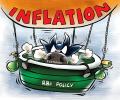
Das said that global economic activity has remained fragile and the surge in COVID-19 cases has subdued early signs of revival.

'Without a poverty line, how are we to know whether poverty is the same, or it has come down or it has gone up?'

The RBI must first deal with the adverse turn of events in the CPI.

Having exposure to international funds and gold is a must for those who have foreign currency-denominated goals.

The newest entrant to the Rs 46-trillion mutual fund (MF) space - Zerodha - plans to focus strictly on the low-cost passive segment and offer its products solely through the commission-free digital route, as it aims to replicate its broking success in the MF space. "We will offer an array of exchange-traded funds (ETFs) and index funds that would help investors take varied exposures and build portfolios based on their financial needs and risk tolerance. "Zerodha Fund House (FH) products will be exclusively distributed online and available as direct plans to engage directly with individual investors and consumers, taking advantage of the pronounced shift from physical to digital interactions," said Vishal Jain, chief executive officer, Zerodha FH.

The rate of price rise was at 6.77 per cent in June last year.

The government will unveil the Consumer Price Index data and the Wholesale Price Index data for August on Monday.

Repo rate may well end 2013 at 8 per cent, where it had begun the year.

'While every year presents new challenges, it also provides opportunities for better growth and performance.'
.jpg)
A section of the market believes RBI should hold rates as negative real rates will hurt savings and investment.

The biggest risk to India's growth outlook is an escalation of geopolitical tensions, especially if these tensions spread to the Asian region, RBI Monetary Policy Committee (MPC) member Jayanth R Varma said on Wednesday. Varma, in an interview to PTI, said that inflation and inflationary expectations appear to be moderating and high inflation will certainly not become the 'norm' in the country. He is cautiously optimistic about the Indian economy as after the pandemic abated, consumption demand has begun to recover though the recovery is uneven across sectors and industries.

Even as banks and finance companies are reporting record-high earnings, their weighting in the benchmark National Stock Exchange Nifty50 Index has seen a downward trajectory. Investors expect a stronger performance from other sectors in the new year. Currently, banking, financial services and insurance (BFSI) companies collectively hold a weighting of 34.5 per cent, down from 36.7 per cent at the end of December 2022 and a record high of 40.6 per cent at the end of December 2019. This represents the sector's lowest weighting in the index since December 2021 when it stood at 33.7 per cent.

The increase is in accordance with the accepted formula, which is based on the recommendations of the 6th Central Pay Commission, it said.

'Gold could benefit from the resulting risk aversion, as happened last year.'

Inflation based on the Wholesale Price Index cooled to a 5-year low of 1.77 per cent in October driven by softening prices of fuel and food items.

Amid fears of a third wave of coronavirus pandemic and hardening of retail inflation, the Reserve Bank is likely to maintain status quo on interest rate and watch the developing macroeconomic situation for some more time before taking any decisive action on monetary policy. The RBI is scheduled to announce its bi-monthly monetary policy review on August 6 at the end of the three-day meeting -- August 4-6 -- of the Monetary Policy Committee (MPC). The RBI Governor-headed six-member MPC decides on the key policy rates.

Dabur India has been the worst performer in the fast-moving consumer goods (FMCG) space this year (CY23), posting a 1 per cent decline even as its peer index, the Nifty FMCG, has delivered returns of over 29 per cent in this period.

'Valuations of midcaps and smallcaps have reached very high levels, and hence to that extent leave little margin of safety.'

Oil and select auto heavyweights bore the brunt of selling pressure; ONGC, RIL, Tata Motors, M&M key losers.

The WPI number follows retail inflation (CPI) data, which had slipped to a record low of 3.78 per cent in July.

When oil prices collapse from $110 to $45, economic agents in India experience a large income windfall.
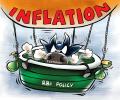
Analysts say RBI will cut rates because the liquidity crunch that began this time last year is still hurting the economy and also with an eye on the August industrial production numbers, which showed a contraction by 1.1 per cent -- the steepest in seven long years.

If credit is not going to flow in response to a policy rate cut, while inflationary pressures, as well as expectations, may be stoked, a rate cut may not be appropriate at this point
